

When you start scrolling through dating profiles, it doesn't take long before everything begins to blur together. You’ll see the same handful of phrases repeated almost like a script: "I love to laugh," "I’m equally happy staying in or going out," and the ever-present "I love travelling." While these things might be true, they don’t actually say much about who you are as an individual. When you use the same language as everyone else, you inadvertently hide the very parts of your personality that would actually make someone want to meet you.
The reason many of us end up sounding like a generic brochure is often down to a mix of nerves and the desire to be "likable." We try to present a version of ourselves that we think others want to see—someone adventurous, constantly active, and effortlessly fun. However, the goal of a profile isn’t to appeal to every single person on an app; it’s to help the right person recognise you. If your profile is too polished or sounds like a marketing pitch, it loses the warmth and character that makes a real-life conversation so much better than a digital one.
"Authenticity isn’t about being perfect or sounding impressive; it’s about giving someone a clear window into what your daily life actually looks like."
Focusing on authenticity over "impressiveness" takes the pressure off. You don't need to have climbed a mountain or have a high-flying career to be interesting. Most people are looking for a genuine connection with a person whose company they would enjoy on a quiet Tuesday night, not just on a holiday. When you stop trying to sound like a "catch" and start sounding like yourself, you’ll find that the people who reach out are much more likely to be on your wavelength.
How to write a profile that feels specific and natural
The secret to writing a profile that sounds like you lies in the details. Instead of using broad labels, try to describe the specific ways those labels manifest in your life. If you say you’re "active," that could mean anything from running marathons to taking the dog for a walk around the local park. Providing a snapshot of your reality makes you far more memorable than a list of adjectives ever could.
Consider the difference between these common approaches:
- Generic: "I love travelling and spending time with friends."
- Personal: "I’m happiest planning a weekend away, finding somewhere good to eat, and convincing friends to stay for one more coffee."
- Generic: "I’m active and enjoy keeping fit."
- Personal: "I usually start Saturday with a walk or a swim, but I’m equally happy cancelling ambitious plans for a long lunch."
- Generic: "I enjoy music and going to gigs."
- Personal: "I’ve still got my old vinyl collection and usually spend Sunday mornings hunting for something new at the local markets."
When you use specific examples, you give the other person a "hook"—something easy to respond to. If you mention that you're currently trying to master a sourdough starter or that you’re re-watching a specific classic comedy series, it’s much easier for someone to say, "I’ve always wanted to try that" or "That’s my favourite show too." It moves the conversation past "Hey, how are you?" and into something much more substantial.
Humour is another area where many people feel pressured to perform. You don't need to be a stand-up comedian. In fact, forced jokes often come across as trying too hard. The best kind of humour in a profile is the kind that reflects your real-life style—whether that’s a bit of self-deprecation, a dry observation about your own quirks, or a lighthearted take on your hobbies. If you aren't naturally someone who cracks jokes constantly, don't feel you have to do it in your bio. A warm, sincere tone is just as effective as a witty one.
Warning: Be careful with "empty labels" like "loyal," "honest," or "fun-loving." These are traits that are better demonstrated through your actions and the way you interact, rather than stated as facts. Everyone thinks they are honest and loyal; showing your personality through your interests and the way you write will prove these traits much more effectively than just claiming them.
What to include, what to avoid, and when to update it
While honesty is vital, it’s important to find a balance with privacy. You should give people a sense of your life without revealing sensitive details like exactly where you work, your home address, or specific routines that could compromise your safety. Official safety guidelines often suggest keeping your profile focused on your personality and interests rather than your logistics until you’ve built a level of trust with someone.
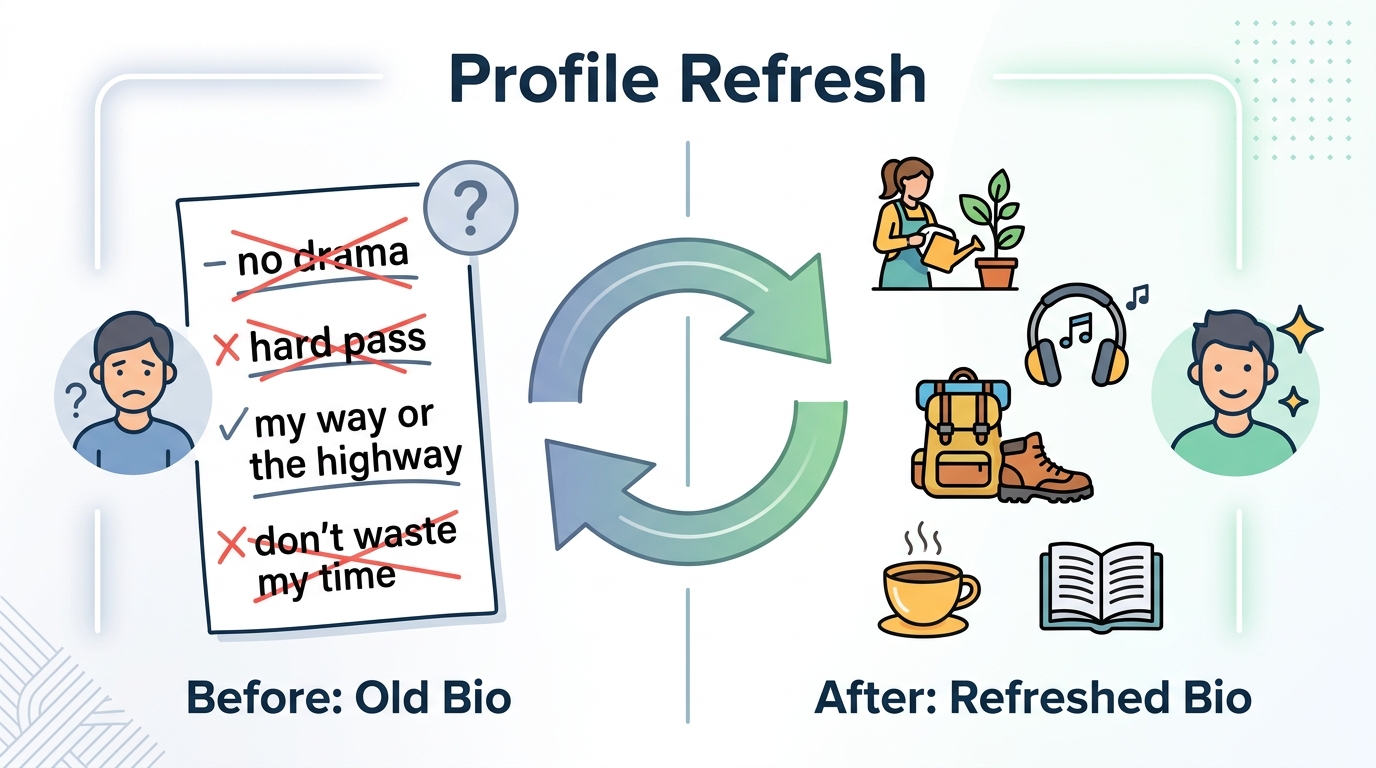
One of the most common mistakes people make is turning their "what I’m looking for" section into a demanding shopping list of requirements. Long lists of "must-haves" and "deal-breakers" can come across as cynical or negative, even if you don't mean them to. Instead of saying "No time-wasters" or "Must love dogs," try to frame it positively. For example, "I’d love to meet someone who enjoys getting out of the house on weekends" or "Bonus points if you're comfortable around a very energetic Kelpie." This shows what you value without sounding like you’re already disappointed in the people reading your profile.
Avoid bringing negativity about past dating experiences into your bio. Phrases like "Not looking for games" or "Hopefully there are still some real people left here" can be a red flag for others. It suggests that you might be carrying baggage or frustration from previous interactions. Keep your tone positive and forward-looking; you want to attract someone based on who you are now, not who you were hurt by in the past.
If you find that your profile sounds a bit too formal—perhaps a bit like a LinkedIn summary—try reading it out loud. If it doesn't sound like something you would actually say to someone over a drink or a coffee, it probably needs a rewrite. Don't be afraid to use contractions (like "I’m" instead of "I am") or a slightly more casual sentence structure. It’s a dating profile, not a job application.
Finally, remember that your profile is a living document. As your interests change or you find yourself in a different phase of life, your profile should reflect that. If you’ve spent the last six months getting into gardening or you've recently decided you want to focus more on finding a long-term partner, update your text. An updated profile not only keeps things accurate but also signals to others that you are active and genuinely engaged in the process.
Ultimately, a strong dating profile doesn't need to be a masterpiece of literature. It doesn't need to sound clever, excessively polished, or impressively busy. Its only job is to give another person a realistic sense of what you are like, what your life feels like on a normal day, and what starting a conversation with you might be like. By being specific, keeping things positive, and using your own natural voice, you make it much easier for the right person to find you and say hello.